


Spatial and Temporal Disorientation
One of the first symptoms of Alzheimer’s disease and related disorders is spatial and temporal disorientation, i.e., a difficulty in finding one’s way in time and space.
From time to time, we all forget the exact date or day of the week without causing us too much concern. In the case of spatio-temporal disorientation, it is rather a progressive disorganization that manifests itself by:
- Repeating requests for the time of day and forgetfulness of associated actions (forgetting to take medication, missing an appointment)
- Confusing the times of day (getting ready for dinner in the morning)
- Confused about the season or year (the person does not know what year it is)
- Mixing up the life stages (the person believes that he or she should drive his or her children to school when they are already adults)
- Difficulty finding one’s way around in new places and eventually even familiar places becoming unfamiliar.
What causes these changes in behaviour?
Neurodegenerative diseases affect specific areas of the brain more than others. When it comes to spatial and temporal disorientation, two systems in the brain are most affected: memory and the processing of visual stimuli. In order to remember the date, episodic (everyday) memory must be intact. To recognize ourselves and remember places, in addition to memory, visual processing must work well to recognize what is in front of us. Alzheimer’s disease often causes changes in both of these functions, resulting in disorienting behaviours.
This difficulty in orienting oneself in time complicates communication with loved ones and causes confusion and anxiety for the person with Alzheimer’s disease. The level of autonomy decreases as the person must regularly call on family and friends to remember appointments, tasks to be done, or to find their bearings in time.
What can be done about it?
Fortunately, several solutions can be put in place in order to maintain some autonomy during the mild and moderate stages of the disease.
|
|
First of all, the simple fact of establishing a routine reassures your loved one. He or she knows what to expect at a given time, associates a specific time of day with a specific action, etc. This allows him or her to be secure about what’s coming. |
| Similarly, establishing a calendar of events may be useful in the early stages of the disease. Involving the person in developing the calendar and then placing it prominently will restore their ownership. |  |
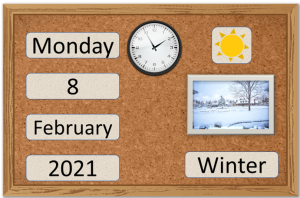 |
Orientation charts are commonly used in seniors’ residences to locate residents by day, season, year, and physical location. |
| The use of an hourglass or timer to determine the duration of an activity can be useful when the person needs a reminder, such as when brushing their teeth. |  |

Finally, the use of a calendar clock – also known as an ephemeral clock – will go a long way in helping your loved one find his or her way through time. Ideal for the light and moderate stages, these clocks allow easy reading of the day of the week, date, and time. Some models even indicate the time of day. Other models can incorporate alarms and voice reminders to let your loved one know it’s time to take a medication or go to an appointment.
These clear, easy-to-read markers are reassuring and help reduce anxiety while preserving independence.


